Showing posts with label Fascinating Research. Show all posts

27 May, 2013

The Lost Secrets of Rome OR Great, Now We'll Have to Learn It All Over Again!

Some time around 2,500 years ago, an upstart republic started trading, negotiating, and generally bullying their way into an empire. On the way it picked up and made up an impressive array of technology the likes of which that part of the world had never seen. When that empire collapsed around 400 AD, that part of the world stopped seeing it for around 1,000 years.

In case you haven't guessed, I'm talking about Rome, yo.

Julius Caesar
Yo.
Whilst doing research on various topics for various writing assignments, I've starting to stumble across a fascinating trend with Roman advancements:

They came up with a lot of stuff that pretty much disappeared from Europe. Seriously. Most of this stuff didn't begin to show up again until the Renaissance.

Michelangelo's David
Right back atcha, Caesar.
What's funny is that a lot of this stuff is still used today. Sure, we use upgraded materials, fancy techniques, and machines instead of slaves, but the basics are still very similar.

Some of these you may have already heard about:

Roman Lead Pipe
Plumbing. Complete with poisonous lead pipes.
(Which, by the way, we used until the mid-20th century.)

Roman Latrines
Indoor Sewers/Bathrooms
Men still use troughs like that at stadiums.

Roman Aqueduct
Aqueducts. Sometimes stretching hundreds of miles.
Notice these are closed, unlike the aqueducts in California.
But there were some other technologies that kind of blew my mind. Not only because they had them waaaayyy earlier than I thought Europeans did, but because they all completely disappeared from Europe for hundreds of years.

Like concrete. The Romans used it to built all sorts of things, like enormous, river-spanning works that still stand to this day.

Pont du Gard
The Pont du Gard aqueduct in France.
That's right: They built a river OVER a river.
And if you've been to Rome, you've probably seen the Pantheon (and the "classy" McDonalds right across from it), or at least seen it on your guidebook maps.

The Pantheon
This guy.
(This picture taken from right in front of the McDonalds.)
The Pantheon is STILL the largest unreinforced concrete dome in the world. And that title's pretty secure, since modern building codes require rebar.

Pantheon dome
You and your building codes can go to Hades!
"If they're so cool," asks Cynical Reader, "Then why is everything gray and boring?"

News flash, CR: They weren't. Turns out all of those buildings were brightly painted, the paint just wore away over thousands of years. Don't believe me? Check out the paintings from Pamplona that were protected from erosion.

Pamplona art
Not gray.
Also, not sure what they're doing,
but there's way too much nudity for it to be boring.
Like the Renaissance, the Romans were fans of paintings with nude figures, or at least figures with diaphanous clothing. Maybe it's because they kept their houses so warm using their underfloor heating systems.

Seriously. They called them hypocausts, and they were designed to heat the houses by heating the tiles that made the floors. Modern systems are doing this using plumbing and electric wires as an efficient and green heating method.

Roman Hypocaust
The Romans used slaves.
The system clearly still had some bugs in it.
For those of you who like industrial machines (and honestly, who doesn't?), the Romans also had incredible advancements in construction machines. Like the pile driver.

Pile Driver repoduction
More sophisticated than the later "Big Man with Big Hammer" system.
"Still," says Cynical Reader. "They didn't have our modern socio-economic infrastructure. You know, like shopping malls."

Firstly, CR, I'm a little sad you brought that up as your objection. Secondly, BAM:

Trajan's Forum
Ladies and Gentlemen: Trajan's Forum.
The world's first shopping mall.
You read that correctly. Trajan's Forum had space for apartments up top and shops on the bottom. Various arcades allowed people to connect to different areas and go to totally different shops right next door to each other. There were also central gathering areas where food vendors set up. You know, like a food court.

So next time you go to the mall, make sure you wear a toga and sandals. If anyone asks, just tell them you're kickin' it old school Trajan style.

Make sure you don't mention me when they throw you out.

25 March, 2013

Tracking Writing OR Graphs Are Fun!

My path to fiction writing has been a strange one. Sure I wrote short stories, papers, poems, and other such things as a kid, but thinking of writing as useful rather than fun took a bit. It started with writing my own monologues for auditions in high school. An acting teacher had mentioned the idea, and combing through plays to find an already written perfect match seemed so much harder than just making one up.

I probably should have taken the hint and focused on writing then and there, but we all have our own paths, jah?

From there it was playwriting in college, then years of pursuing screenwriting before ending up at fiction. My current project? Taking a story that I loved as a script and turning it into a novel. The good part? I get to include all of the juicy world bits that couldn't be crammed in the mere 112 pages of script. The bad part? Novels are frikkin' LONG.

"What?!?" says our friend Cynical Reader. "Are you saying novels are harder?!?!? Are you saying scripts are easier and thus less valid?!?!?!?"

First, you should really tone down the punctuation, CR. Second, let's just say that since a picture is worth a thousand words, when you go from movie to book someone has to write those thousand words.

Fortunately, my amazing wife (who is also a writer) pointed me in the direction of WriteTrack. (Website located here: http://nano.davidsgale.com)

**Ahem** Seems we need to register and login...
Hold on a second...
WriteTrack is free (awesome!), but generous souls can donate to keep the lights on. And it does exactly what the name implies:

It keeps track of what you write.

Namely your goal, how much you need to have done at this point, and how much you actually have done by this point.

Forget Science and Technology...
...THIS is what Progress looks like!
It works by setting up challenges. For example, I had 35,000 words of an estimated 100,000. I decided I wanted to finished my rough draft by May 1st, so I entered in 65,000 as my goal, and...


Voila! Numbers on a calendar!
Every day you simply enter in how many actual words you wrote, and it redistributes the remaining words across the given time period. Wrote more than you need? Great! That's less you'll have to write later. Wrote less? Then get to work, slacker!

Truth be told, I completely love this thing for the graphic elements that it does automatically. Sure, I could do all the math and keep track on a spread sheet. If I did it would look just like the raw data report you can access.

Hooray. A data table. It's so exciting...
I could even make simple line graphs normally associated with stock prices:

Sell, damn it, SELL!
However like a magpie I also enjoy shiny things, and the ease of entering in a single number every day to get neat looking graphs is a completely wonderful feeling.

Take, for example, the daily performance graph.

Orange is NormalVille.
My blue is in the land of Awesome.
But how does such exceptional performance (if I do say so myself) add up in the long run? Who knows?!?

Oh wait. The total progress graph knows.

The Total Progress Graph knows ALL.
As any writer can attest it is really easy to get a little lost in the middle mire when writing a book/script/poem. I've seen people get lost in the middle of haikus.

You start to feel like each day is disconnected from the next, and at night that little voice in your head starts saying, "What's it matter if you don't write today? It's just one day... You deserve to eat that ice cream. A little ice cream never hurt anyone. Also you shouldn't exercise. And should sleep for, like, 72 hours straight. And every meal should be pizza. Topped with chocolate."

Well I'm gonna lay it out right here, right now: That voice is a punk. And not the cool kind with dye in their hair and metal in their face. That voice is the kind who I can't describe without unintentionally pissing someone off. It's that offensive.

And call me weird, but something about being accountable to those little blue and orange lines makes me shove that punk away and get writing.

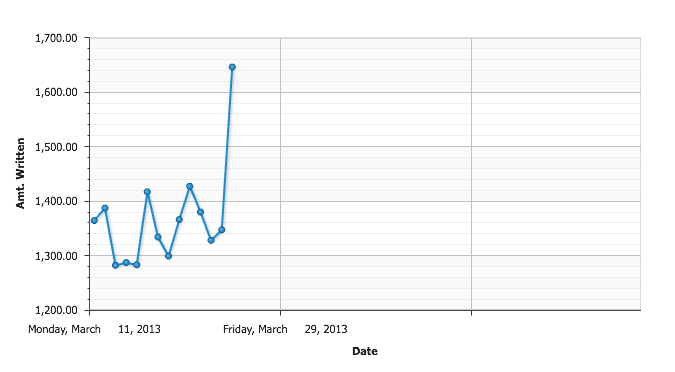
Because it's easy to feel down on yourself while writing. But it's a nice kick in the ego pants to produce graphs like this one:
Every day I have exceeded 100%.
That's right: I have defied the laws of math.

That being said, sometimes we can't write for very good, non-punk related reasons. Say we're going on a trip, or have to pull a really long day at work, or the kids are sick.

Fortunately, WriteTrack ALSO has you covered there by allowing you to adjust the weight of each day in percentages.

Having no kids, mine are all at 100%.
That sound you just heard is all of my friends who are parents slapping me.
Now this may not work for everyone. But for some awesome reason it motivated my wife, and it's motivated me.

You know how many words I wrote in February? Me neither. I didn't keep track that well, but I can tell you it wasn't much.

You know how many I've written in the last two weeks? 19,000.

I'm not bragging here (okay, maybe a little), but I've clearly shoved that punk voice away from center stage.

Seriously though, this isn't just about bragging. Not only do I find this tool and all the data fascinating, but I'm also fascinated about how well it works.

It's not like I have anyone to answer to but myself. I'm the only who sees this goal. I don't have an agent or publisher waiting on the deadline. Even the possibility of making money from the book is at best a dim hope in the future at the end of many obstacles, so the threat of not making money off it has no teeth in the slightest.

But the graph becomes tangible. It becomes a very real thing that I see at the end of every day, a moment when I can pause and say to myself, "Well, Self, it seems you have created something quantifiable today."

And I can look back and say, "Ummm... Okay, I really need to stop talking to myself so vividly. But that is an awesome graph."

11 February, 2013

Mini Muskets & Paper Revolvers OR Eighty Years is a Long Time

To keep everyone from suffering from Museum Of Children Overload Stress Trauma (Mo COST), I'm switching it up this week with a category of the other things that fascinate me. Namely:
Things I find out while researching things for writing.

This week's research: Stuff I found out about Civil War armaments.

When I went to school, I was told that they used rifled muskets in the Revolutionary War. Then when they got to the Civil War, they used... Rifled muskets.

The Civil War was just like this, but with better uniforms.

As I got older, I realized there were some other advancements: Better artillery, better tactics, and, towards the end of the war, the Gatling Gun.

Thankfully he had an awesome name.
No one would fear the Smithers Gun.

In high school I took AP US History, and while I may have missed something (I did get a B), I seem to remember it had far more dates, battles, obscure laws, and names than any specific firearm technology.

I did vaguely remember they used the "Mini-Ball," which I assumed was just like it sounded: A musket ball, but smaller.

This high-tech graphic brought to by Easily Fascinated Technologies.

Boy was I wrong.

It turns out that in the 80 years between the two wars there WAS advancement. And rather a lot.

The "Mini-ball" was, in fact, the Minie Ball, a grooved bullet-shaped round that could be stored in a paper cartridge.

Not, in fact, a ball at all.

When fired, the bullet formed to the barrel's rifling, thus making it spin, and in turn making it go father much more accurately.

But that wasn't the biggest thing that blew my mind. That was reserved for the carbine rifle, which is definitively NOT a rifled musket.

This thing was breech-loading, meaning it was loaded from the back instead of by jamming things down the barrel like the rifles used by infantry.

To reload: Jam in paper cartridge. Place blasting cap on the nipple.
Stop giggling. Fire. Repeat.

It was less accurate, but was smaller and could be reloaded in about half the time. I found a YouTube video of someone firing it, and it's actually pretty impressive to watch.

Because of COURSE YouTube has videos of people firing 150 year old weapons!


The last thing that caught my attention was the revolver. Like most people in this country, when I think of a revolver I picture a western standoff, like somehow technology magically went from single-shot dueling pistols to Clint Eastwood

Progress!

Again my knowledge was woefully inadequate and full of holes, like low quality Swiss cheese.

In the Civil War they had six-shot revolvers loaded by, you guessed it, paper cartridges. They were loaded by jamming the paper cartridge into the front of the chamber, ramming it in place, then putting a percussion cap on the nipple at the back of the chamber.

The 1860 Navy Colt. When empty, it contains enough steel to make a handy club.

Only officers, cavalry-men, and people who could generally afford the $20 gun had these. Since the infantry only made $13 a month, that wasn't a huge number. But it was still a revolver, capable of holding six loaded chambers at once and moving through them rapidly.

Now I'm very sure that people who are really into the Civil War and guns knew about this for decades. But to be self-centered: I didn't. And what really caught my attention was that it finally bridged the gap in my knowledge between the Revolutionary War and the Wild West.

Because every now and then I like to remember that technological progress isn't done by some magical leap forward when someone decides that they should start using electricity instead of candles. Technological progress happens at the end of many, many small steps and improvements that finally culminate in a totally new way of looking at things.


Picture credits:
1 - Battle of Bunker Hill By Howard Pyle
2 - Source: National Park Service
4 - Source: WikiCommons public license
5 - Source: National Park Service
6 - Source; http://youtu.be/TByvrQ6-OLQ
7 - Duel: Published before 1923 and public domain in the US, Western duel: Old Town Temecula. (http://best-temecula-guide.com/slider/old-town-temecula/)
8 - Source: WikiCommons public license